
Abstract
When one considers arbitration in the context of climate change, investment arbitration often comes to mind. However, this article proposes to take a step back and ponder if commercial arbitration also has a role to play in this fight. In order to ascertain the role (if any) that this private dispute resolution mechanism can play in humanity’s fight against climate change, this piece analyses public data to investigate if climate change related disputes represent a significant portion of active arbitral proceedings. If a sizeable portion of current arbitral proceedings comes from disputes that can further the goal of transition and adaptation to a green economy or mitigation of greenhouse gas emissions, this article will question whether institutional arbitration rules are well-equipped to deal with those types of cases. It is then concluded that climate change disputes are already a reality, and that the arbitral community has a responsibility to appropriately accommodate them.
1. Overview of climate change litigation and scope of the article
In the wake of the 26th United Nations Climate Change Conference (COP26), there is a clear gap between what was hoped would be achieved and what was feasible. The contrast is striking when one compares the speeches given by the United Nations’ (UN) Secretary General before and after COP26’s completion. At first, the Secretary General encouraged world leaders to use their influence to ensure the success of COP26, noting that solving the climate crisis ‘requires coordination and cooperation on a scale we have never seen before’.1 However, after COP26 came to a rather disappointing end in November 2021,2 he stated that the commitments in the final agreement were a compromise that reflected ‘the interests, the conditions, the contradictions and the state of political will in the world today’.3
Legal efforts to combat climate change are not a new phenomenon. In 1990, the UN General Assembly commenced the development of international climate change (transnational) legislation by passing UN Resolution 45/212.4 This started formal negotiations that eventually culminated in the adoption of the United Nations Framework Convention on Climate Change (UNFCCC) in 1994.5 After the UNFCCC entered into force, further negotiations took place to prepare a protocol that would ‘delineate State roles and responsibilities’,6 resulting in the Kyoto Protocol7 in 1997, which, in turn, was complemented by the Paris Agreement8 in 20159 after ‘contentious multilateral negotiations’.10
Notwithstanding these efforts, it is still difficult to measure the extent to which international climate change law has been effective in responding to the climate crisis.11 Commentators have noted that even where international dispute settlement mechanisms exist, they are considered ineffective due to a lack of mandatory rules or enforcement procedures.12 Hence, ‘international adjudication is unlikely to provide effective relief, either in reducing emissions or compensating victims’.13
When considering why climate change dispute resolution mechanisms are necessary, the answer is multi-layered. To prevent irreversible damage to the earth’s climate, humanity needs to significantly reduce its greenhouse gas emissions to a level that, before the year 2100, keeps the global average temperature below the threshold of a 2ºC increase.14 To achieve this, massive investments will have to be made. For instance, Article 9(1) of the Paris Agreement stipulates that developed countries should provide financial resources to assist developing countries in mitigating climate change as well as adaptation to sustainable ways to maintain their economy in the future.15 To that end, the UNFCCC’s so-called ‘Financial Mechanisms’ have, to date, obtained pledges totalling 10 billion dollars.16 These combined efforts will include new contracts and, consequently, many disputes – particularly in the areas of energy, land, urban and infrastructure and industrial systems.17 In each one of these areas, dispute resolution agreements are not only widely utilised, but are essential in guaranteeing a timely, technically correct, and effective decision.
When arbitration is mentioned in this context, it is usually focused on arbitration under investment treaties, where scholars have suggested it ‘has the potential to considerably limit the instability that currently affects the implementation of climate change mitigation policies’.18 Even those that recognised the limits of investment arbitration as a deterrent to climate change have stated that arbitrators ‘can contribute to global climate governance’.19 However, this article proposes a different approach: to take a step back from investment arbitration and look at commercial arbitration. As this particular form of conflict resolution is applied only to private disputes, it will be questioned if commentators and practitioners alike have properly considered the role commercial arbitration can play in climate change litigation.
In 2019, the International Chamber of Commerce (ICC) commissioned a taskforce to prepare a report on climate change and climate change-related disputes, the latter defined as ‘any dispute arising out of or in relation to the effect of climate change and climate change policy, the UNFCCC and the Paris Agreement’.20 The ICC Commission Report is not the only paper on this matter, as a similar approach was taken by the UN Environment Programme in its Status of Climate Change Litigation Report21 and later the Arbitration Institute of the Stockholm Chamber of Commerce (SCC) used the same concept in its Green Technology Disputes in Stockholm.22
The ICC Commission Report proposed that climate change disputes could arise out of three different scenarios: (i) specific transition, adaptation or mitigation contracts;23 (ii) contracts not specifically related to transition, adaptation or mitigation; and (iii) submission agreements (or compromis).24 The first two categories have also been called (i) direct and (ii) indirect climate change disputes by commentators,25 the latter being the focus of the present analysis and referred to as ‘wide ranging and potentially cover[ing] all types of contracts involving human activity’.26 Despite its large scope, this definition is not without merit. A transition consistent with the goal of mitigating greenhouse gas emissions will impact contracts in a wide spectrum of sectors, ranging from obvious ones such as energy, infrastructure, transport, and agriculture to less conspicuous areas such as supply chain disputes.27 Simply put, standards of doing business will have to change, and there is an international consensus that the private sector has an important role in the transition to a green economy.28 The question this article seeks to uncover is then two-fold. Firstly, how significant is indirect climate change arbitration today? Secondly, are arbitration centres prepared to deal with it accordingly?
To better analyse the role (if any) commercial arbitration can play in the fight against climate change, Part 2 analyses public data made available by major international arbitration centres to ascertain whether indirect climate change disputes represent a significant portion of active arbitral proceedings. Following this, through the lenses of climate change litigation, Part 3 will consider whether there is room for improvement in these institutions’ rules. Part 4 will then conclude that climate change disputes are already a reality, and that the arbitral community has the responsibility of appropriately accommodating them.
This article is by no means a complete analysis of this subject, but it hopes to spark further debate as to what can be improved so that arbitration can reach its full potential in the fight against climate change.
2. Data on indirect climate change litigation
Whenever one attempts to compare publicly available data on commercial arbitration, two issues tend to arise. The first concerns the veil of confidentiality traditionally considered as an important advantage associated with arbitration as a dispute resolution mechanism.29 Despite a long-standing debate concerning the general need for more transparency,30 the reality is that its treatment is currently unsatisfactory,31 meaning that most institutions’ arbitration rules contain express confidentiality provisions32 and not many procedural mechanisms to promote transparency. This issue presents a different facet when one is looking for data about the nature of disputes administered by arbitration centres, which, in turn, leads to the second challenge. While the major international arbitration centres have been publishing general statistics about their caseload for years, their reports are not standardised. This is particularly significant for the question at hand.
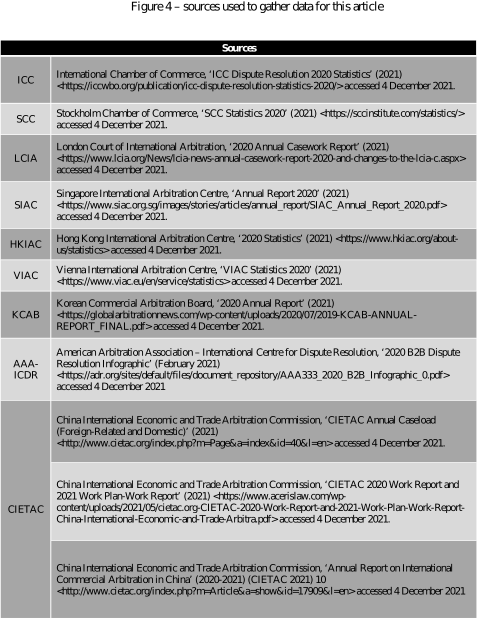
This analysis will take into consideration 13 arbitration centres that usually publish statistics about their casework33 and have had their data compared by the Global Arbitration News in 2021.34 Out of the 13, six had to be set aside from this article.35 There are four reasons for this: (i) two institutions did not reveal the nature of the disputes administered;36 (ii) two institutions, as will be highlighted below, did not have data that was consistent with the others, and therefore needed to be set aside to maintain a set of comparable information;37 (iii) one institution, despite being mentioned in the Global Arbitration News, did not publish any data from 2020;38 and (iv) one institution is mainly a hub for investment arbitration39 (i.e. investor-State and State-State disputes under the International Centre for Settlement of Investment Disputes (ICSID) Convention) and is hence outside the scope of this article.
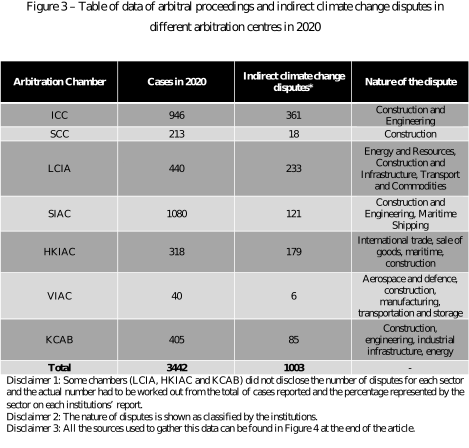
In this context, the set of available information encompasses a universe of 3442 arbitral proceedings across the world, a considerable amount by all accounts. Among these cases, 1003 can be considered as indirect climate change disputes, using the definition established in Part 1. This amounts to approximately 29% of all arbitral proceedings in 2020. This information can be better visualised in the figures below:


Apart from these figures, it is also important to mention the case of two institutions: the International Centre for Dispute Resolution (ICDR) and the China International Economic and Trade Association (CIETAC).
In the ICDR’s case, the report is brief and only mentions the institution’s highlights about its caseload.40 It reported that in 2020 the chamber has seen a 52% surge in disputes involving aviation, aerospace and national defence matters,41 as well as a 15% increase in disputes from the transportation sector.42 However, the exact number of proceedings are not disclosed.
The CIETAC is a slightly more complicated case. Although there are reports available, they are not always clear about the nature of the disputes.43 However, since 2015, the centre annually produces a report about the status of international commercial arbitration in China. The latest report shows that China’s arbitration commission handled 13340 cases arising from construction matters alone and 158 from the agriculture sector,44 both of which are considered indirect climate change disputes.
When one frames the debate using the definition of indirect climate change litigation, all the data discussed above demonstrates that climate change arbitration is already a reality, and the international arbitration community has a responsibility to be aware of this fact. Whenever new issues such as climate change arbitration arise, it might be useful to take inspiration from William Park’s approach to an arbitrator’s ‘truth-seeking’ duty45 by looking at the issues from a middle ground which he calls the ‘hilltop’46 – far enough from the issue to consider theoretical questions, but also close enough not to lose sight of the end goal. In the context of our discussion, the end goal would be using arbitration to adequately respond to the already ongoing phenomenon of climate change-related disputes.
3. Is there room for improvement within indirect disputes procedural rules?
Using the criteria established in Part 2, there are hundreds of arbitral proceedings worldwide that can be characterised as indirect climate change disputes because of their subject matter. One could even make the argument that if one adds all the indirect climate change disputes from various arbitration chambers shown in Figure 3 together with the reported construction and agribusiness cases from the CIETAC, the final number could be well over 14000. In this context, two topics need to be addressed: transparency and third-party participation. These issues are of paramount importance because, if not dealt with, they can hamper the public’s ability to know what matters are being resolved through arbitration and affect the content of awards rendered by the arbitrators. As argued below, this is important because indirect climate change litigation can impact certain communities and contribute to global climate governance. Citing commentators: ‘[i]n the absence of strong government action to address climate change, rulings in climate change litigation may serve as a de facto source of national climate policy with very real impacts on the regulatory landscape.’47
Although only a few cases capable of having severe impacts on third-parties outside the scope of the arbitration agreement have been reported,48 some serve to demonstrate how far-reaching the consequences of indirect climate change disputes can be. For example, in ICC Case No. 14297,49 the arbitral tribunal found that a provider of environmental engineering services, which was responsible for assisting a metallurgical company by providing it with services aimed at developing environmental protection measures and improving its energy efficiency, could seek compensation for an alleged abusive50 termination of its contract. Similarly, the arbitrators in ICC Case No. 1272751 condemned a company responsible for the decontamination of a polluted site for not having ensured that the emissions of landfill gas there had ceased.
Commercial disputes have also been reported to arise in contracts concerning carbon credits. In this area, the Permanent Court of Arbitration (PCA) is the institution that has the most experience, having administered nine cases since the 1997 Kyoto Protocol,52 notwithstanding the fact that there were no commercial indirect climate change disputes reported by this institution in 2020. One earlier case, however, was ‘a commercial contract dispute involving Asian hydroelectric companies and a European company’.53 This supports the argument that carbon credits disputes have (and will probably) arise more frequently out of various scenarios, including disagreements over bookkeeping, allegedly erroneous transfer of credits, verification reports from third-party auditors and more.54
These examples serve to highlight that while arbitral tribunals are not environmental gatekeepers, they may have to consider relevant issues of climate change related disputes55 ultimately affecting more than just the parties. When that is the case, the people affected by the tribunal’s decision should be able to have information about the state of the proceedings. This is not to say that such large consequences will arise in every indirect climate change dispute. In fact, in most cases, it is more likely that the dispute will be of concern only to the parties themselves. Even where the circumstances of the case may impact third-parties or the community at large, it should be noted that the arbitral tribunal still has the responsibility to ensure that sensitive commercial or financial information, proprietary ‘know-how’, and any other so-called ‘trade secrets’ are protected and not made available to the public.
3.1 Transparency issues
Increasing transparency in commercial arbitration is especially difficult since there is no universal rule regarding a proceeding’s confidentiality, and national laws often differ on the matter.56 The same can be said when one attempts to raise the question of ‘public interest’ to access a proceeding’s records, with different approaches and rationales in different jurisdictions.57 Moreover, although some lessons may be taken from the investment arbitration experience,58 the fact is that current rules from all the aforementioned chambers still face challenges when it comes to providing information to the public.
The ICC’s rules are the most advanced out of the centres discussed in this article, as it allows for some degree of transparency.59 The ICC regularly publishes: (i) the names of the arbitrators, (ii) their nationality, (iii) their role within an arbitral tribunal, (iv) the method of their appointment, and (v) whether the arbitration is pending or closed.60 Furthermore, the ICC has traditionally published redacted versions of arbitral awards for decades, and its recent rules do not foresee any change in this regard.61 The Vienna International Arbitral Centre (VIAC) has also begun to publish the names of the arbitrators62 in the proceedings it administers. Apart from this, any other issue of confidentiality that may arise in an ICC arbitral proceeding can be decided by the arbitral tribunal, including the power to take measures to protect trade secrets and confidential information.63
The rules from the other six centres considered in this study essentially have two types of provisions. The first is the provision of confidentiality to the chamber, parties, arbitrators, and assistants.64 The second is rules for the publication of arbitral awards, provided the names of parties and any other sensitive information are redacted, although this provision is only present in five of the chambers analysed (including the ICC, as mentioned above).65
Apart from arbitration chambers, it is also likely that in the future, the parties themselves, especially large companies, may want to provide more transparency in the arbitrations in which they are involved. Commentators have proposed that ESG (Environmental, Social and Governance) related investments could have social benefits, although they may be associated with lower expected returns.66 However, if used in conjunction with the framework proposed by the Task Force on Climate-related Financial Disclosures (TCFD),67 which focuses on disclosing financial implications of climate-related risks and dependencies rather than revealing a corporation’s impacts on climate change, the chances of improving transparency in climate change related disputes might increase.68 For instance, some jurisdictions, such as the United Kingdom and Brazil, have already put in place TCFD-aligned regulations that will enter into force on 6 April 2022 and 1 February 2023 respectively.
3.2 Third-party participation
Third-party participation69 is a relevant topic when discussing multi-faceted disputes, as they have the potential to involve different actors, some of which may not be participants in the dispute70 or even signatories of the arbitration agreement. As mentioned in the ICC Commission Report,71 climate change related disputes might involve matters of public interest affecting citizens or populations. As such, the implementation of a uniform set of rules regulating their participation would be useful.
In the realm of commercial arbitration, usual mechanisms for the involvement of third-parties are the joinder of additional parties and consolidation of proceedings. All the chambers considered in the present study have specific provisions on both.72 However, whenever the matter of participation in the proceeding of a non-signatory party to the arbitration agreement is brought up, the answer boils down to consent. As commentators have noted, ‘consent must be found somewhere, in some form, or there will be no proper basis for requiring the non-signatory to arbitrate’.73 This is a sensitive matter, as it may jeopardise the validity of the award under the New York Convention.74
As mentioned above, this article does not aim to provide an in-depth analysis on the institutions’ procedural rules, and merely states that the centres under consideration are no stranger to joinder and consolidation matters. However, these mechanisms may not be the appropriate tool to provide transparency when dealing with indirect climate change disputes. This is because the party seeking to intervene may have no interest in the claim itself, but is merely interested in the dispute’s environmental implications, whether those were intended by the original parties of the arbitral proceeding or otherwise. In fact, reports show that public interest groups and Non-Governmental Organisations (NGOs) have initiated various disputes aiming to hold States accountable for climate change-related commitments.75 Following the same rationale, it is not unreasonable to question whether commercial arbitration disputes involving large corporations are next in line.
An alternative may lie in an often overlooked mechanism in commercial arbitration: amicus curiae participation. Common in the investment arbitration world, none of the arbitral rules studied in this article have provisions on this topic for commercial arbitrations. Due to this, scholars argue that ‘there is very little basis for a tribunal to permit amicus curiae participation in an international commercial arbitration absent the parties’ consent’.76 Considering that in climate change disputes there may be questions about transition, mitigation and adaptation projects or programmes capable of impacting local populations and surrounding ecosystems,77 it is important for the arbitration community to develop instructions in this area.78 This is further supported when one considers that amicus curiae submissions alone, without full access to the arbitration, are not enough to ensure the transparency and legitimacy the matter deserves.79
4. Conclusion: What role can commercial arbitration actually play?
This article has shown that arbitration proceedings of indirect climate change disputes are, at least presently and in quantitative terms, already a reality. Therefore, even as an inter-party dispute settlement mechanism, commercial arbitration has a ‘foot in the door’ when it comes to climate change litigation. That being the case, there are at least two areas in which significant improvements can be made, namely transparency and amicus curiae participation. This article hopes to spark further debate on these topics from a different perspective.
I would like to thank Dr Jan Kleinheisterkamp for his valuable feedback on this article. All views and opinions expressed are my own.
[1] António Guterres, ‘Secretary-General’s remarks to the Security Council – on addressing climate-related security risks to international peace and security through mitigation and resilience building’ (Speech at the UN’s Security Council, New York, 23 February 2021) https://www.un.org/sg/en/content/sg/statement/2021-02-23/secretary-generals-remarks-the-security-council-addressing-climate-related-security-risks-international-peace-and-security-through-mitigation-and-resilience-building accessed 4 December 2021.
[2] Catherine Brahic, ‘COP26 ends with a pact that is neither a triumph nor a trainwreck’ The Economist (London, 13 November 2021) https://www.economist.com/international/2021/11/13/cop26-ends-with-a-pact-that-is-neither-a-triumph-nor-a-trainwreck accessed 4 December 2021.
[3] António Guterres, ‘Secretary-General’s statement on the conclusion of the UN Climate Change Conference COP26’ (Speech at COP26, Glasgow, 13 November 2021) https://www.un.org/sg/en/node/260645 accessed 4 December 2021.
[4] UNGA Res 45/212 (21 December 1990) UN Doc. A/RES/45/212.
[5] Cinnamon Carlarne, Kevin R. Gray and Richard Tarasofsky, ‘International Climate Change Law: Mapping the Field’ in Cinnamon Carlarne, Kevin R. Gray and Richard Tarasofsky (eds), The Oxford Handbook of International Climate Change Law (Oxford University Press 2016) 4.
[6] ibid 7.
[7] Kyoto Protocol to the United Nations Framework Convention on Climate Change (adopted 10 December 1997, entered into force 16 February 2005) UNTS 148 (Paris Agreement).
[8] Paris Agreement to the United Nations Framework Convention on Climate Change (adopted 12 December 2015, entered into force 4 November 2016) UNTC I-54113 (Kyoto Protocol).
[9] Daniel Bodansky, Jutta Brunnée and Lavanya Rajamani, International Climate Change Law (Oxford University Press 2017) 209.
[10] ibid.
[11] ibid 359.
[12] ibid 289.
[13] ibid.
[14] For an overview of the severity of climate change and the role of dispute resolution in the fight against it, see Lucy Greenwood, ‘The Canary Is Dead: Arbitration and Climate Change’ (2021) 38(3) Journal of International Arbitration 309, 326.
[15] Paris Agreement to the United Nations Framework Convention on Climate Change (adopted 12 December 2015, entered into force 4 November 2016) UNTC I-54113 (Paris Agreement) art 9(1) reads as follows: ‘Developed country Parties shall provide financial resources to assist developing country Parties with respect to both mitigation and adaptation in continuation of their existing obligations under the Convention.’
[16] For more information on climate change finance see: (i) Green Climate Fund, available at https://www.greenclimate.fund/ accessed 4 December 2021; (ii) Wendy Miles and Nicola Swan, ‘Climate Change Financing and Dispute Resolution’ in Sherlin Tung, Fabricio Fortese and Crina Baltag (eds), Finances in International Arbitration: Liber Amicorum Patricia Shaughnessy (Kluwer Law International 2019) 323 – 346.
[17] ICC Arbitration and ADR Commission, ‘Resolving Climate Change Related Disputes through Arbitration and ADR’ (International Chamber of Commerce, November 2019) (ICC Commission Report) para 2.3 <https://iccwbo.org/content/uploads/sites/3/2019/11/icc-arbitration-adr-commission-report-on-resolving-climate-change-related-disputes-english-version.pdf> accessed 3 March 2022.
[18] Anatole Boute, ‘Combating Climate Change through Investment Arbitration’ (2012) 35 Fordham International Law Journal 613, 663.
[19] Valentina Vadi, ‘Beyond Known Worlds: Climate Change Governance by Arbitral Tribunals’ (2015) 48 Vanderbilt Journal Transnational Law 1285, 1351.
[20] ICC Commission Report (n 17) para 2.1.
[21] The UN Environment Programme’s 2017 Global Climate Change Litigation Report defines climate change disputes as ‘cases brought before administrative, judicial and other investigatory bodies that raise issues of law or fact regarding the science of climate change and climate change mitigation and adaptation efforts’ (United Nations Environment Programme, ‘The Status of Climate Change Litigation: A Global Review’ (29 November 2017) 10 <https://www.unep.org/resources/publication/status-climate-change-litigation-global-review> accessed 3 March 2022).
[22] Sukma Dwi Andrina, ‘Green Technology Disputes in Stockholm’ (Arbitration Institute at the Stockholm Chamber of Commerce (SSC) 2019) https://sccinstitute.com/media/1059447/green-technology-disputes-in-stockholm.pdf? accessed 4 December 2021.
[23] The expressions ‘transition’, ‘adaptation’ or ‘mitigation’, as used in the ICC Commission Report, refer to contracts related to climate change matters that will need to be transitioned, adapted, or mitigated in order to meet the goals set by the Paris Agreement.
[24] ICC Commission Report (n 17).
[25] Laurent Gouiffès and Melissa Ordonez, ‘Climate change in international arbitration, the next big thing?’ (2021) Journal of Energy & Natural Resources Law 10 https://www.tandfonline.com/doi/full/10.1080/02646811.2021.1959158 accessed 4 December 2021.
[26] ibid 11.
[27] ICC Commission Report (n 17) para 2.5.
[28] Lucia Bíziková, ‘On Route to Climate Justice: The Greta Effect on International Commercial Arbitration’ 39(1) Journal of International Arbitration 79, 89.
[29] Nigel Blackaby and others, Redfern and Hunter on International Arbitration (6th edn, Oxford University Press 2015) 251.
[30] For an in-depth review about the discussion around the need for more transparency in arbitration, see: Jan Paulsson and Nigel Rawding, ‘The Trouble with Confidentiality’ (1995) 11 Arbitration International 303; Constantine Partasides and Simon Maynard, ‘Raising the Curtain on English Arbitration’ (2017) 33(2) Arbitration International 197; Wendy Miles and Nelson Goh, ‘Transparency v Confidentiality: A Fork in the Road for Arbitration?’ in Gourab Banerji and others (eds), International Arbitration and the Rule of Law: Essays in Honour of Fali Nariman (Permanent Court of Arbitration 2021).
[31] Gary Born, International Commercial Arbitration (3rd edn, Kluwer Law International B.V. 2021) 223.
[32] ibid 142.
[33] The arbitration chambers are, in alphabetical order: CIETAC (China International Economic and Trade Arbitration Commission); DIS (German Arbitration Institute); HKIAC (Hong Kong International Arbitration Centre); ICC (International Chamber of Commerce); ICDR (International Centre for Dispute Resolution); ICSID (International Centre for Settlement of Investment Disputes); KCAB (Korean Commercial Arbitration Board); LCIA (London Court of International Arbitration); PCA (Permanent Court of Arbitration); SCAI (Swiss Chambers’ Arbitration Institution); SCC (The Arbitration Institute of the Stockholm Chamber of Commerce); SIAC (Singapore International Arbitration Centre); VIAC (Vienna International Arbitral Centre).
[34] Markus Altenkirch and Elias Klodt, ‘Arbitration Statistics’ 2020 – In Full Sail Through the COVID Storm (Global Arbitration News, 12 October 2021) https://globalarbitrationnews.com/arbitration-statistics-2020/ accessed 4 December 2021.
[35] The arbitration chambers that had to be left out of this analysis are: (i) DIS; (ii) PCA; (iii) CIETAC; (iv) ICDR; (v) ICSID; and (vi) SCAI.
[36] DIS and PCA.
[37] CIETAC and ICDR.
[38] SCAI.
[39] ICSID.
[40] American Arbitration Association – International Centre for Dispute Resolution, ‘2020 B2B Dispute Resolution Infographic’ (February 2021) https://adr.org/sites/default/files/document_repository/AAA333_2020_B2B_Infographic_0.pdf accessed 4 December 2021.
[41] ibid.
[42] ibid.
[43] These reports can be accessed through the following links: (i) China International and Trade Arbitration Commission, ‘Statistics’ http://www.cietac.org/index.php?m=Page&a=index&id=40&l=en accessed 4 December 2021; and (ii) China International and Trade Arbitration Commission, ‘2020 Work Report and 2021 Work Plan’ (May 2021) https://www.acerislaw.com/wp-content/uploads/2021/05/cietac.org-CIETAC-2020-Work-Report-and-2021-Work-Plan-Work-Report-China-International-Economic-and-Trade-Arbitra.pdf accessed 4 December 2021.
[44] China International Economic and Trade Arbitration Commission, ‘Annual Report on International Commercial Arbitration in China (2021 – 2021) (2021) 10 http://www.cietac.org/index.php?m=Article&a=show&id=17909&l=en accessed 4 December 2021.
[45] William W. Park, ‘Arbitrators And Accuracy’ (2010) 1 Journal of International Dispute Settlement 25.
[46] ibid 26. Park explains the view from the hilltop as follows: ‘Finally, a view from the hilltop (somewhere between the trenches and the Alpine peaks) looks at how goals other than truth-seeking enter the equation. Examining documents and listening to witness testimony will cost time and money. At some point, the additional enlightenment to be gleaned from more information will be offset by the value of finality and economy. The present essay explores this last line of inquiry, looking at how truth-seeking balances against sensitivity to speed and economy in arbitration.’
[47] Jacqueline Peel, ‘Issues in Climate Change Litigation’ (2011) 5(1) Carbon and Climate Law Review 15, 23.
[48] Patrick Thieffry, ‘International Arbitration of Climate-Related Disputes: Prospects for Alternative Dispute Resolution’ in Ivano Alogna, Christine Bakker, and Jean-Pierre Gauci (eds), Climate Change Litigation: Global Perspectives (Brill Nijhoff 2021) 470.
[49] ICC Case No. 14297 in Jean-Jacques Arnaldez, Yves Derains and Dominique Hascher, Collection of ICC Arbitral Awards 2008 – 2011 (Kluwer Law International 2013) 879-884.
[50] ibid 879. According to the claimant, the termination of the contract was abusive because the respondent had unilaterally terminated the contract without respecting the obligations to provide contractual notice or pay the balance of the invoices.
[51] ICC Case No. 12727 reported by Emmanuel Jolivet and Laurence Marquis, ‘Arbitrage commercial international et litiges environnementaux: illustrations dans des affaires récentes’ (2011) 1 Cahiers de l’Arbitrage 91.
[52] Alison Ross, ‘The PCA and climate change’ (Global Arbitration Review, 10 December 2015) https://globalarbitrationreview.com/the-pca-and-climate-change accessed 2 March 2022.
[53] David W. Rivkin and Catherine Amirfar, ‘Climate Disputes and Sustainable Development in the Energy Sector’ in Maxi Scherer (ed), International Arbitration in the Energy Sector (Oxford University Press 2018) para 18.28; Judith Levine, ‘Information about the Activities of the Permanent Court of Arbitration in Environmental Disputes in the Context of Energy Projects’ (Conference on Arbitration of Energy Disputes: New Challenges, Copenhagen, 1-2 (September 2014) http://voldgiftsinstituttet.dk/wp-content/uploads/2015/01/levine_-_pca_environment__26_energy_activities.pdf accessed 4 December 2021.
[54] Lisa Hodes Rosen and Adrienne Bossi, ‘Due Process Rights in the Carbon Markets’ (2011) 11(2) Sustainable Development Law & Policy 9-14, 75-76.
[55] Patrick Thieffry, ‘L’arbitrage et le droit européen de l’environnement’ (2019) 4 Revue de l’arbitrage 1069.
[56] George Burn and Alison Pearsall, ‘Exceptions to Confidentiality in International Arbitration’ in International Chamber of Commerce International Court of Arbitration, Confidentiality in Arbitration: Commentaries on Rules, Statutes, Case Law and Practice (Paris International Chamber of Commerce Services 2009) 23.
[57] Ileana M. Smeureanu, Confidentiality in International Commercial Arbitration (Kluwer Law International 2011) 312.
[58] For more transparency mechanisms of investment arbitration see: (i) United Nations Commissions on International Trade Law, ‘UNCITRAL Rules on Transparency in Treaty-based Investor-State Arbitration’ (New York 2014) https://uncitral.un.org/sites/uncitral.un.org/files/media-documents/uncitral/en/rules-on-transparency-e.pdf accessed 4 December 2021; (ii) Annette Magnusson, ‘New Arbitration Frontiers: Climate Change’ in Jean Kalicki and Mohamed Abdel Raouf (eds), Evolution and Adaptation: The Future of International Arbitration (Kluwer Law International 2020) 1010.
[59] ICC Commission Report (n 17) para 5.72.
[60] International Chamber of Commerce, ‘Note to Parties and Arbitral Tribunals on the Conduct of the Arbitration Under the ICC Rules of Arbitration’ (1 January 2021) para 51 https://iccwbo.org/publication/note-parties-arbitral-tribunals-conduct-arbitration/ accessed 4 December 2021.
[61] ibid para 57.
[62] The list of VIAC Arbitral Tribunals can be found at: Vienna International Arbitral Centre, ‘VIAC Arbitral Tribunals’ https://www.viac.eu/en/arbitration/viac-arbitral-tribunals accessed 4 December 2021.
[63] International Chamber of Commerce, ‘Arbitration Rules’ (1 January 2021) art 22(3).
[64] The provisions on confidentiality can be found for each chamber at:
(i) Stockholm Chamber of Commerce, ‘Arbitration Rules’ (1 January 2017) art 3.
(ii) London Court of International Arbitration, ‘LCIA Arbitration Rules’ (1 October 2020) art 30.
(iii) Singapore International Arbitration Centre, ‘SIAC Rules’ (1 August 2016) Rule 39.
(iv) Hong Kong International Arbitration Centre, ‘Administered Arbitration Rules’ (1 November 2018) Article 45.
(v) Vienna International Arbitral Centre, ‘VIAC Rules of Arbitration and Mediation 2021’(1 July 2021) arts 2(4), 4(4) and 16(2).
(vi) Korean Commercial Arbitration Board, ‘International Arbitration Rules’ (1 June 2016) art 57; and
(vii) Korean Commercial Arbitration Board, Domestic Arbitration Rules’ (2016) art 12.
[65] Besides the ICC, the chambers with provisions for publication of arbitral awards are:
(i) London Court of International Arbitration, ‘LCIA Arbitration Rules’ (1 October 2020) art 30.3; and London Court of International Arbitration, ‘Notes for Parties’ art 19.
(ii) Hong Kong International Arbitration Centre, ‘Administered Arbitration Rules’ (1 November 2018) art 45.5.
(iii) Korean Commercial Arbitration Board, ‘International Arbitration Rules’ (1 June 2016) art 57(3); and
(iv) Korean Commercial Arbitration Board, ‘Domestic Arbitration Rules’ (2016) art 12(3).
[66] Bradford Cornell, ‘ESG Preferences, Risk and Return’ (2020) 27(1)European Financial Management 12.
[67] Task Force on Climate-Related Financial Disclosures, ‘Recommendations of the Task Force on Climate-related Financial Disclosures’ (15 June 2017) https://assets.bbhub.io/company/sites/60/2021/10/FINAL-2017-TCFD-Report.pdf accessed 4 December 2021.
[68] More information on those provisions in the UK are available at Department for Business, Energy & Industrial Strategy, HM Treasury, John Glen MP and The Rt Hon Greg Hands MP, ‘UK to enshrine mandatory climate disclosure for largest companies in law’ (gov.uk, 29 October 2021) https://www.gov.uk/government/news/uk-to-enshrine-mandatory-climate-disclosures-for-largest-companies-in-law and in Brazil at Ministério da Economia, Comissão de Valores Mobiliários, ‘CFM promove alterações na Instrução CVM 480’ (gov.br 22 December 2021) https://www.gov.br/cvm/pt-br/assuntos/noticias/cvm-promove-alteracoes-na-instrucao-cvm-480 accessed 4 December 2021.
[69] The expression ‘third-party participation’ is used to when referring to parties that are not bound by the arbitration agreement used to initiate a particular arbitral proceeding (Loukas A. Mistelis, ‘Confidentiality and Third Party Participation: UPS v. Canada and Methanex Corporation v. United States’ (2014) 21(2) Arbitration International 211.
[70] Gouiffès and Ordonez (n 25) 13.
[71] ICC Commission Report (n 17) para 5.80.
[72] Provisions on joinder of additional parties:
(i) International Chamber of Commerce, ‘Arbitration Rules’ (1 January 2021) art 7.
(ii) Stockholm Chamber of Commerce, ‘Arbitration Rules’ (1 January 2017) art 13.
(iii) London Court of International Arbitration, ‘LCIA Arbitration Rules’ (1 October 2020) art. 22(1)(x).
(iv) Singapore International Arbitration Centre, ‘SIAC Rules’ (1 August 2016) Rule 7.
(v) Hong Kong International Arbitration Centre, ‘Administered Arbitration Rules’ (1 November 2018) art 27.
(vi) Vienna International Arbitration Centre, ‘VIAC Rules of Arbitration and Mediation’ (1 July 2021) art 14; and
(vii) Korean Commercial Arbitration Board, ‘International Arbitration Rules’ (1 June 2016) art 21.
Provisions on consolidation of arbitrations:
(i) International Chamber of Commerce, ‘Arbitration Rules’ (1 January 2021) art 10.
(ii) Stockholm Chamber of Commerce, ‘Arbitration Rules’ (1 January 2017) art 15.
(iii) London Court of International Arbitration, ‘LCIA Arbitration Rules’ (1 October 2020) art 22A.
(iv) Singapore International Arbitration Centre, ‘SIAC Rules’ (1 August 2016) Rule 8.
(v) Hong Kong International Arbitration Centre, ‘Administered Arbitration Rules’ (1 November 2018) art 28;
(vi) Vienna International Arbitration Centre, ‘VIAC Rules of Arbitration and Mediation’ (1 July 2021) art 15; and
(vii) Korean Commercial Arbitration Board, ‘International Arbitration Rules’ (1 June 2016) art 23.
[73] John M. Townsend, ‘Extending an Arbitration Clause to a Non-Signatory Claimant or Non-Signatory Defendant: Does it Make a Difference?’ in Bernard Hanotiau and Eric A. Schwartz (eds), Multiparty Arbitration, Dossiers of the ICC Institute of World Business Law, (Volume 7 International Chamber of Commerce 2010) 111, 117.
[74] As argued by scholars: ‘Multiparty arbitration is also fraught with considerable problems. In particular, it is essential to show that the parties have actually consented to this type of arbitration and that they are treated equally since the lack of consent as well as any unequal treatment of the parties are grounds of resisting enforcement under the New York Convention’ (Julian D. M. Lew, Loukas A. Mistelis and Stefan M. Kröll, Comparative International Commercial Arbitration (Kluwer Law International 2003) 378).
[75] See ICC Commission Report (n 17) para 3.5.
[76] Gary Born and Stephanie Forrest, ‘Amicus Curiae Participation in Investment Arbitration’ (2019) 34(3) ICSID Review – Foreign Investment Law Journal 626, 643.
[77] ICC Commission Report (n 17) para 5.81.
[78] Bíziková (n 28) 106; Gouiffès and Ordonez (n 25) 13.
[79] Nigel Blackaby and Caroline Richard, ‘Amicus Curiae: A Panacea for Legitimacy in Investment Arbitration?’ in Michael Waibel and others (eds), The Backlash against Investment Arbitration_: Perceptions and Reality_ (Kluwer Law International 2010) 253, 273.
Felipe Caldas Verás
Master’s Degree (Federal University of Minas Gerais) ’20, LLM (LSE) ’22 and Private International Law Notes Editor of the LSE Law Review 2021-22